





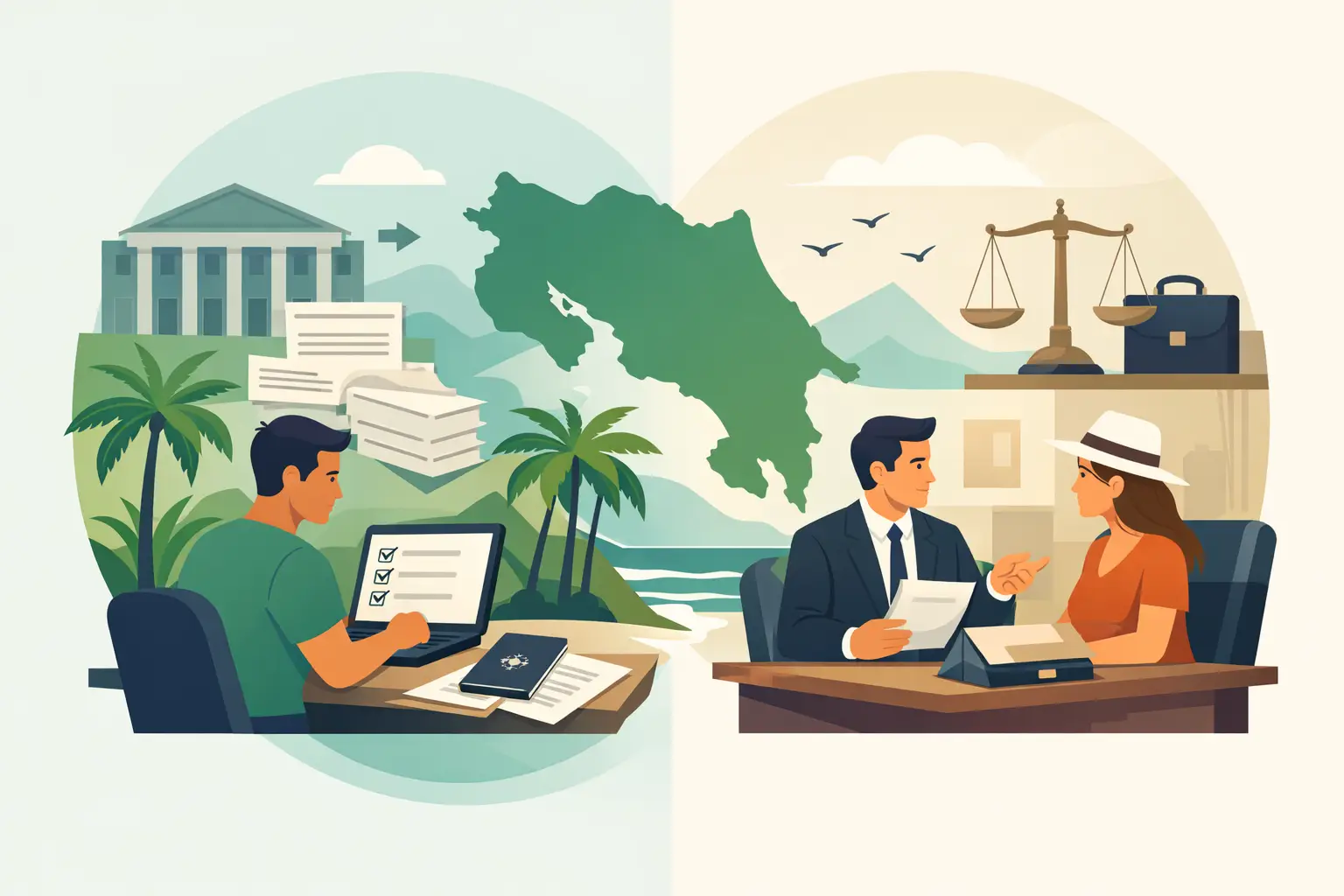
DIY Residency vs Legal Assistance in Costa Rica
Some people start the Costa Rica residency process with a simple goal: save money by doing it themselves. That can work in certain cases. But when you look closely at DIY residency vs legal assistance, the real question is not just what costs less on paper. It is what gives you the best chance of getting approved without delays, document problems, or expensive mistakes.
Residency in Costa Rica is not impossible to handle on your own, but it is rarely as straightforward as it first appears. Requirements can shift. Documents must meet specific standards. Timing matters. And for many applicants, the hardest part is not filling out a form. It is knowing whether the form, supporting documents, translations, appointments, and follow-up steps are being handled correctly from the beginning.
DIY residency vs legal assistance: what is the real difference?
At a basic level, DIY means you take responsibility for the process yourself. You gather your documents, track deadlines, confirm current requirements, arrange translations, complete filings, and respond to any issues that come up. Legal assistance means a qualified professional or support team helps manage those steps, reduce errors, and guide your case through the system.
The difference is not only about who does the paperwork. It is about who catches problems before they become delays.
For example, an applicant may think they have a complete set of documents, only to learn that a certificate is outdated, an apostille is missing, or a translation does not meet the necessary standard. On a do-it-yourself path, those mistakes are often discovered late, after time and money have already been spent. With legal support, those issues are more likely to be identified early, when they are easier to fix.
When DIY residency can make sense
There are situations where handling your own residency may be reasonable. If you are highly organized, comfortable working through government procedures, patient with bureaucracy, and able to spend time verifying each requirement, a DIY approach may be possible.
This can be especially true for someone with a relatively simple case. If your residency category is clear, your documents are easy to obtain, and you are already in Costa Rica with flexibility for appointments and follow-up, you may feel comfortable managing it on your own.
Some applicants also prefer DIY because they want direct control over every step. They do not mind researching procedures, asking questions, and making repeated visits if necessary. For those people, the process may feel manageable rather than overwhelming.
Still, manageable does not always mean efficient. A person can complete the process alone and still lose months to avoidable errors or confusion.
Where DIY applications usually get complicated
The most common problems are rarely dramatic. They are small issues that snowball.
A background check may be too old by the time it is submitted. Birth or marriage certificates may need a specific form of authentication. An income document may not be presented in the way immigration expects. A translation may be technically accurate but still unusable if it is not prepared properly. An appointment may be missed because the applicant misunderstood the next step.
Then there is the practical side of relocation. Many people are not handling residency in a vacuum. They are also trying to rent or buy a home, set up utilities, understand the healthcare system, move family members, or settle into retirement. What looked like a money-saving project can quickly become a second full-time job.
That is often where frustration starts. Not because the applicant is careless, but because Costa Rican residency involves legal, administrative, and timing issues that are unfamiliar to most newcomers.
What legal assistance actually helps with
Some people hear "legal assistance" and assume it means handing everything over and stepping away. In reality, good support is more practical than that. You still provide personal records and make decisions, but you have experienced guidance on what is needed, what order to do things in, and how to avoid common mistakes.
Professional help is particularly valuable when your case has any complexity at all. That might include dependents, marriage-based documentation, investment-related residency, pension proof, incomplete records, prior overstay concerns, or uncertainty about which residency category fits best.
Legal assistance can also help with the parts many applicants underestimate: certified translations, document review, filing preparation, appointment coordination, and knowing how to respond when an application needs clarification or additional evidence.
This is where experience matters. A team that works with residency cases regularly can often spot weak points before submission. That does not guarantee a perfect or instant process. No honest provider should promise that. But it can significantly reduce the chance of delays caused by preventable errors.
Cost is only one part of the decision
It is natural to compare prices first. DIY often appears cheaper because you are not paying for professional guidance. But that comparison can be misleading if you only count upfront fees.
A do-it-yourself application still includes government costs, document retrieval, apostilles, translations, travel, and your own time. If anything is rejected or expires before filing, you may have to pay again. If repeated trips, corrected documents, or late-stage fixes become necessary, the savings can narrow quickly.
Legal help costs more upfront, but for many applicants it reduces the risk of duplicate expenses and prolonged delays. It may also save something that matters just as much as money: peace of mind.
For retirees, remote workers, and families coordinating an international move, less stress has real value. So does the ability to ask questions and get dependable answers instead of guessing.
DIY residency vs legal assistance: which option fits your situation?
This choice depends on your risk tolerance, schedule, and the complexity of your case.
DIY may be the better fit if you have time, patience, strong attention to detail, and confidence working through a foreign administrative process. It can also work if you are comfortable dealing with uncertainty and solving problems as they appear.
Legal assistance is usually the stronger choice if you want efficiency, clarity, and support. It is especially worth considering if you are on a timeline, moving with a spouse or children, handling financial documentation from abroad, or simply do not want your residency process to depend on trial and error.
Many applicants are not looking for the cheapest path. They are looking for the safest one. That is a different calculation.
The hidden factor: trust
One reason people hesitate to seek help is fear of paying the wrong person. That concern is valid. Relocating to another country can make you vulnerable to bad advice, incomplete services, or promises that sound reassuring but do not hold up in practice.
That is why the issue is not just DIY versus paid help. It is DIY versus qualified, trustworthy help.
A reliable support provider should be clear about what is included, realistic about processing times, and transparent about what they can and cannot control. They should make the process easier to understand, not more confusing. They should also be able to support the wider practical needs that often surround residency, from translations to insurance guidance to the next administrative steps after approval.
For many expats, that broader support is what makes the difference. Residency is not an isolated task. It is part of building a legal, stable life in Costa Rica.
A practical way to decide
If you are unsure which direction to take, ask yourself a few honest questions. How comfortable are you with legal paperwork in another country? How costly would a delay be for you? Do you have the time to research every step and verify current rules? If something goes wrong, are you prepared to fix it yourself?
If those questions make you feel confident, a DIY route may be workable. If they make you uneasy, that is useful information too.
For many people, the smartest decision is not about proving they can do it alone. It is about choosing the level of support that matches the importance of the move. With more than 30 years of experience helping expatriates establish themselves in Costa Rica, ARCR has seen both paths firsthand.
Residency is a legal process, but it is also a life transition. The right choice is the one that helps you move forward with fewer surprises and more confidence.