





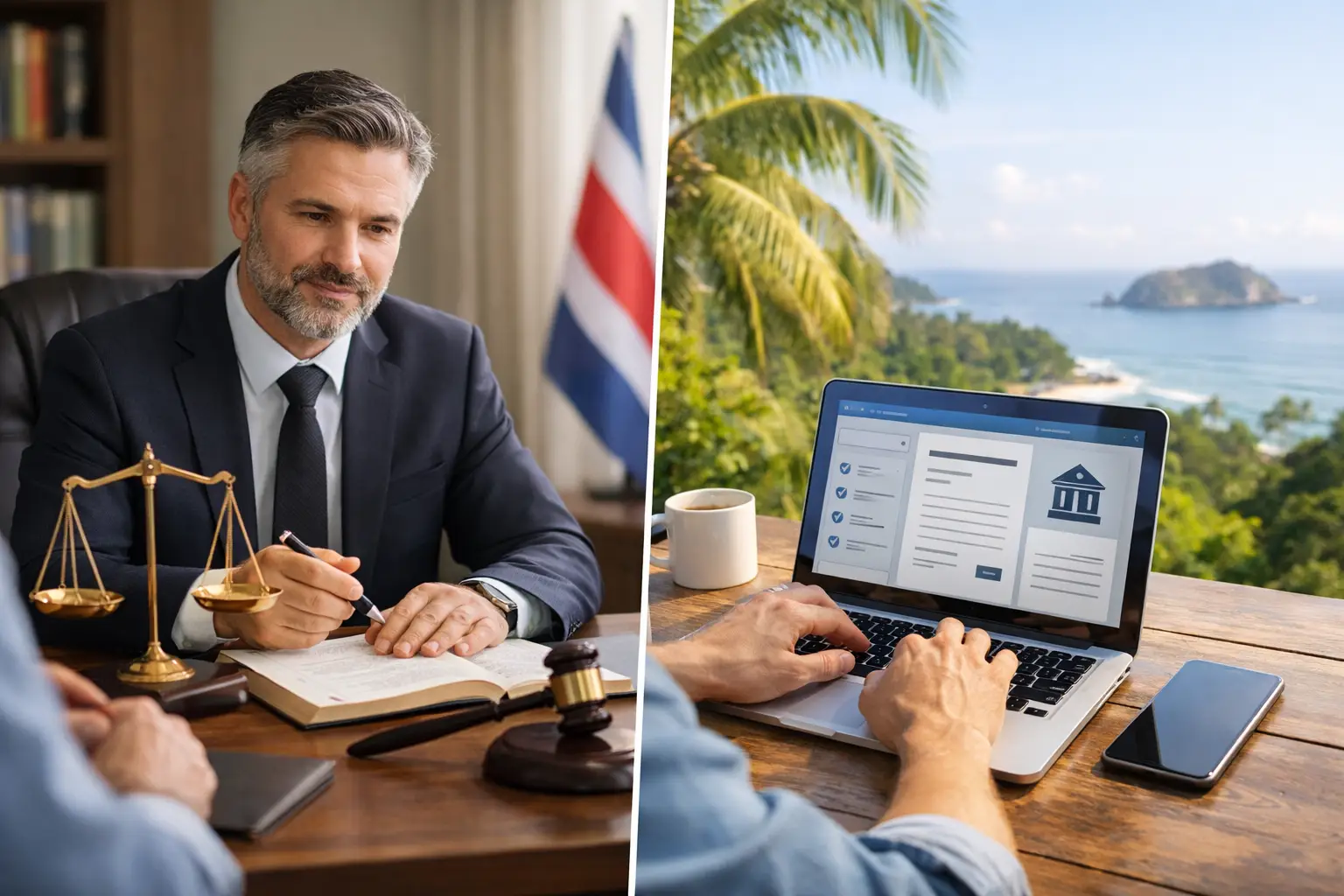
Local Attorney Versus Online Service in Costa Rica
A residency application can look straightforward on a website: gather documents, submit forms, pay fees, and wait. The reality often becomes more complicated once your records cross borders, require certification, or reach a Costa Rican government office with a specific question. Choosing a local attorney versus online service is not just a question of price. It is a decision about who will understand your circumstances, respond when something changes, and help protect your plans to live in Costa Rica.
For some limited tasks, an online service can be useful. But for immigration, legal documents, property matters, business formation, and other decisions that affect your life abroad, the value of qualified local guidance is often felt when the process stops being routine.
What an Online Service Can Do Well
Online legal platforms are designed for standardized needs. They may provide templates, document checklists, basic filing support, and a convenient way to organize information from home. If you need a simple form drafted under the laws of your home state or country, and your situation is uncomplicated, this can be an affordable starting point.
The appeal is understandable. You can compare packages quickly, complete questions at your own pace, and see an advertised price before speaking with anyone. For people who are still researching a move to Costa Rica, an online service may also help them become familiar with common terms and paperwork.
The limitation is that a platform can only work with the information and rules built into its system. It may not recognize that a document needs to be issued recently, apostilled in a particular jurisdiction, translated by an authorized Costa Rican translator, or presented differently because of your residency category. It cannot attend a government appointment, communicate directly with an official, or assess a local issue that does not fit a standard workflow.
Local Attorney Versus Online Service: The Real Difference
The central difference is accountability combined with local knowledge. A Costa Rican attorney who works with foreign residents understands how legal requirements operate in practice, not merely how they appear in a generic checklist.
Costa Rica is welcoming to newcomers, but its administrative processes have their own timing, documentation standards, offices, and terminology. Requirements can change. Individual cases can raise questions. A small discrepancy in a name, date, marital record, pension letter, or corporate document may lead to delays that are frustrating when you are trying to arrange housing, health coverage, banking, or travel.
A local attorney can review the complete picture before a problem becomes expensive. That includes asking the questions an automated system may not ask: Are you applying as a pensioner, investor, rentista, employee, or family member? Will your spouse and children apply with you? Does your source of income meet the applicable standard? Are your birth certificates, marriage certificates, and police records suitable for use in Costa Rica? Do you need powers of attorney, certified translations, or support with a related legal matter?
Just as importantly, a local professional has a duty to explain the scope of representation, provide advice under Costa Rican law, and identify what cannot be promised. That clarity matters in a relocation process where overly broad guarantees are a warning sign.
Residency Is a Process, Not a Single Filing
Many people begin by focusing only on the residency application. Yet residency is usually one part of a larger transition. After approval, you may need to address Costa Rican Social Security enrollment, insurance, a local driver's license, cédula renewals, banking arrangements, estate planning, property questions, or the creation of a business.
An online service may treat each item as a separate transaction. A local attorney and relocation support team can help you see how the pieces connect. For example, the documents used for immigration may affect later administrative tasks. A change in marital status, income source, address, or business activity can have implications that deserve timely guidance.
This does not mean every expat needs the most extensive legal service available. It means your support should match the stakes. If an error would cost you months of delay, require documents to be reissued abroad, or interfere with a planned move, personal review is usually worth considering.
The local advantage when documents are involved
Foreign documents are one of the most common sources of preventable trouble. A document can be legitimate in the United States or Canada and still be unacceptable for a Costa Rican process because it is outdated, lacks an apostille, uses a different name format, or has not been properly translated.
A locally based team can tell you what to obtain before you travel, how current it should be, and whether it needs additional certification. If an issue arises after arrival, you have someone who can explain the next practical step rather than a remote customer support queue that may not be familiar with Costa Rican institutions.
The local advantage when circumstances change
Relocation plans rarely remain perfectly fixed. A retirement date moves, a home sale takes longer than expected, a spouse joins later, a child ages out of dependent status, or an income document needs revision. These are normal situations, but they can change the right path forward.
A local attorney can assess the effect of the change in the context of your actual file. Online systems are often less flexible when a case falls outside their original questionnaire. The result may be generic information when what you need is a clear recommendation for your next move.
When an Online Service May Be Enough
There are situations where an online service can be a reasonable choice. It may suit a person who needs a basic document for use in their home jurisdiction, has no Costa Rica-specific legal question, and is comfortable managing every submission and follow-up independently.
It can also be useful for preliminary education. Reading checklists and general explanations can help you prepare better questions before you engage local support. The key is to understand the boundary: general information is not the same as legal advice tailored to your residency, family, finances, or property interests.
Be especially cautious if a service markets a low flat fee without explaining what is excluded. Ask whether the quoted price includes certified translations, government fees, filing support, responses to requests for additional documents, appointment assistance, and communication after submission. A low initial price can become less attractive when each local requirement is treated as an unexpected add-on.
Questions to Ask Before You Choose
Whether you speak with a local attorney, a relocation organization, or an online provider, ask direct questions. Who will review your documents? Are they qualified to advise on Costa Rican law? What services are included, and what costs are separate? How will they communicate with you if an official requests more information? Can they support you after residency approval with the practical steps of establishing life in Costa Rica?
Also ask how they handle privacy. Residency files contain sensitive records, including identification, financial information, and background documents. You should know where those records are stored, who can access them, and how long they are retained.
Experience matters, but so does transparency. A trustworthy provider will explain the process in plain language, avoid guarantees about government decisions, and help you understand your responsibilities. They should make it easier to make informed choices, not pressure you into a package you do not understand.
Choosing Support That Fits Your Move
The right choice depends on the complexity of your situation and the level of support you want. Someone handling a simple, home-country document may be comfortable with an online platform. A retiree preparing a residency application, a family relocating together, or an investor setting up a Costa Rican business has more moving parts and more to protect.
For more than 30 years, ARCR has helped foreign residents bring those moving parts into one coordinated process, with attorney-backed support and practical assistance before and after arrival. That kind of continuity can be reassuring when your move involves more than forms.
Costa Rica can be a rewarding place to build a new chapter. Give the legal and administrative side the same care you would give choosing a home or planning your finances. The best support is the kind that leaves you informed, prepared, and able to enjoy the life you came here to create.